
How Important Is Anti-Cheating Proctoring (Lockdown vs. AI/Live Webcam Monitoring)?
Introduction,
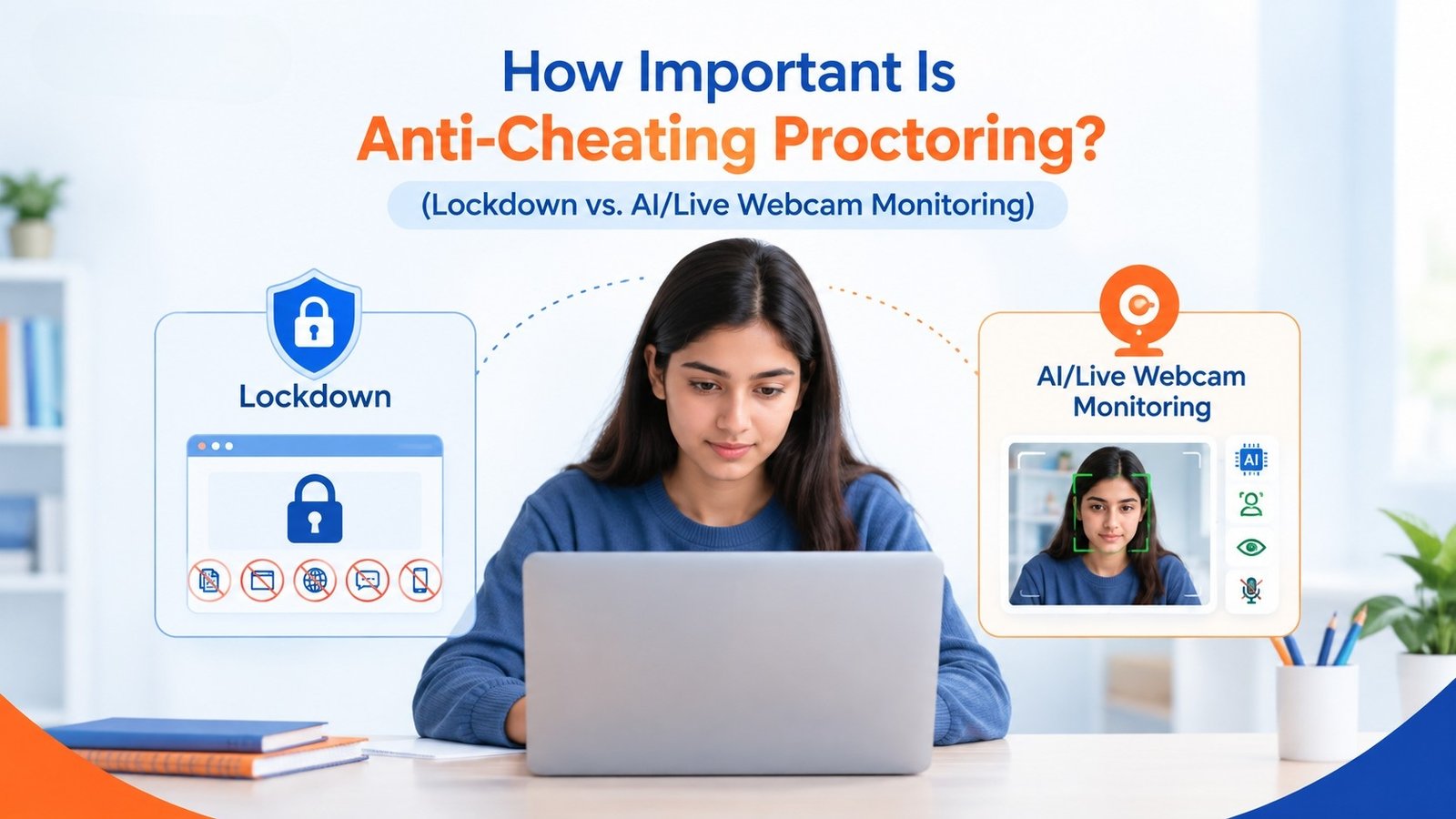
Anti-cheating proctoring has become an important part of modern online assessment. As exams move from classrooms to laptops, desktops, and remote environments, organizations need reliable ways to protect exam integrity without making the candidate experience unnecessarily stressful.
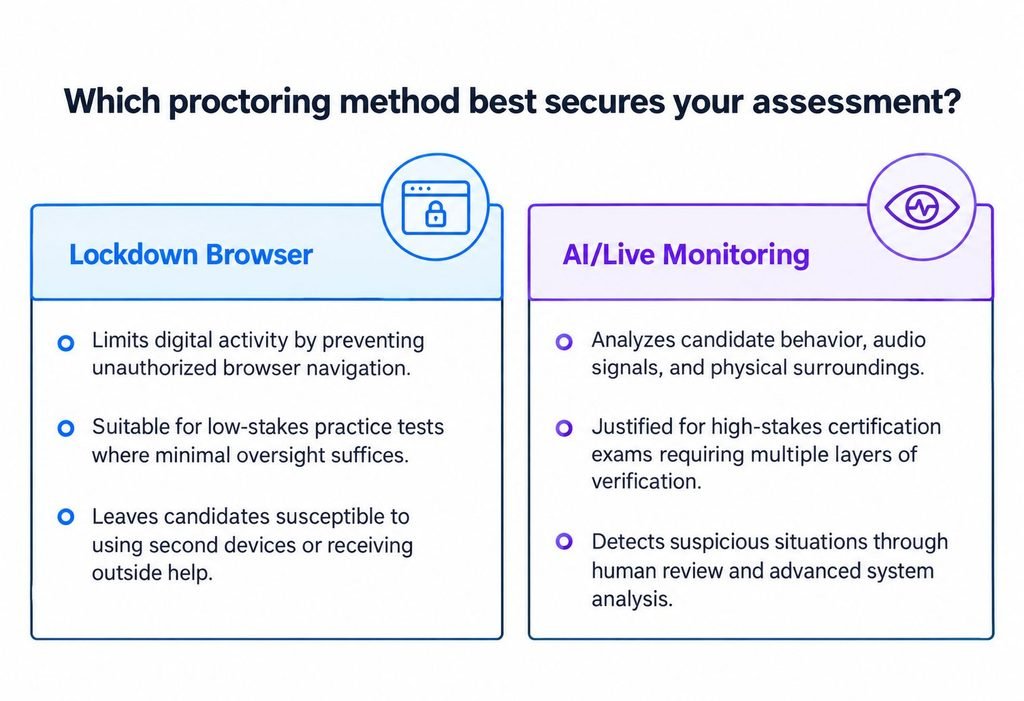
A simple lockdown browser can prevent several forms of digital cheating. However, it doesn’t necessarily know what’s happening around the candidate. Someone could potentially use a second device, receive help from another person, or consult unauthorized material outside the restricted browser.
That’s where AI proctoring and live webcam monitoring comes .
Advanced systems can analyze candidate behavior, webcam activity, audio signals, screen activity, and other exam events. Human proctors can then review or investigate suspicious situations when necessary.
But does every exam need the most advanced technology available?
Not necessarily.
The right approach depends on the risk level, exam purpose, candidate population, privacy requirements, budget, and consequences of cheating. A low-stakes practice test may only require browser restrictions, while a high-stakes certification exam may justify multiple layers of monitoring.
1. What Is Anti-Cheating Proctoring?
Anti-cheating proctoring refers to technologies and processes designed to discourage, detect, document, and help investigate dishonest behavior during an online examination. It can range from simple technical controls to difficult human-supervised systems.
Common approaches include:
- Secure or lockdown browsers
- Tab and application restrictions
- Screen monitoring
- Webcam monitoring
- Microphone monitoring
- Identity verification
- AI behavior analysis
- Face detection
- Multiple-person detection
- Suspicious-object detection
- Audio anomaly detection
- Live human supervision
- Post-exam video review
The important point is that proctoring isn’t a single feature. It’s a security framework.
Why Do Online Exams Need Anti-Cheating Measures?
Traditional classroom exams naturally provide physical supervision. Candidates sit in a controlled location, and invigilators can observe the room. Remote exams remove many of those controls.
A candidate might have access to:
- A smartphone
- Another computer
- Printed notes
- Unauthorized websites
- Messaging applications
- Another person providing assistance
- Remote communication tools
- Search engines or AI tools
Of course, not every candidate will attempt to cheat. In fact, most candidates want a fair assessment.
Still, organizations need to consider risk rather than assumptions.
A strong online assessment system should make cheating difficult while also creating an environment where honest candidates feel confident that everyone is being assessed fairly. That’s particularly important for:
- University examinations
- Professional certifications
- Recruitment assessments
- Entrance tests
- Competitive examinations
- Employee compliance tests
- High-stakes academic assessments
The objective isn’t to watch candidates simply for the sake of watching them. The objective is to protect assessment validity.
2. Lockdown Proctoring: What Does It Actually Do?
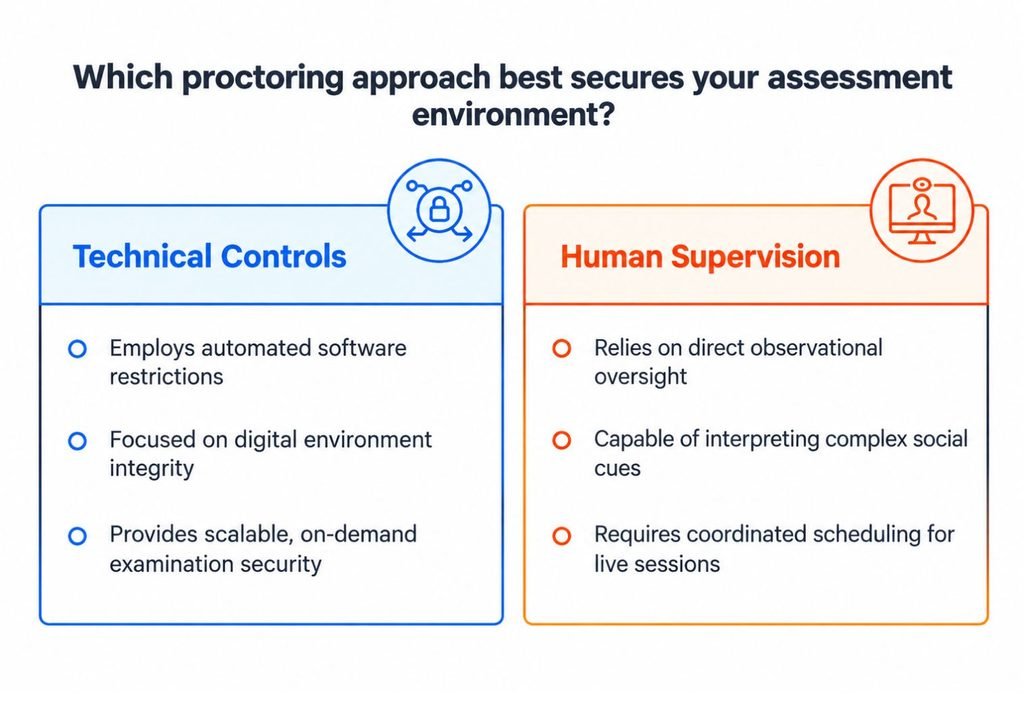
A lockdown browser is one of the simplest forms of online exam security. It restricts what candidates can do on their computer while an exam is running. Depending on the software configuration, it may prevent candidates from:
- Opening new browser tabs
- Visiting other websites
- Switching applications
- Copying and pasting content
- Taking screenshots
- Using certain keyboard shortcuts
- Accessing prohibited applications
This approach creates a controlled digital testing environment.
Major Benefits of Lockdown Proctoring
lockdown technology remains useful because it’s relatively straightforward.
a. Simple Candidate Experience
Candidates generally understand the concept quickly: open the secure environment and complete the exam.
There’s less monitoring complexity compared with a fully proctored session.
b. Reduced Digital Distractions
A lockdown browser can prevent candidates from jumping between:
- Search engines
- Social media
- Messaging platforms
- Other applications
- Additional browser tabs
This can significantly reduce common forms of digital cheating.
c. Easier Administration
For institutions conducting large numbers of assessments, simplicity matters. A lockdown-based approach can require fewer monitoring resources than live proctoring. It may therefore work well for:
- Internal assessments
- Classroom replacement tests
- Low-to-medium-risk quizzes
- Practice assessments
- Coaching institute tests
The technology doesn’t need to be overcomplicated to be useful.
3. AI Webcam Proctoring: A More Intelligent Approach
AI webcam proctoring adds another layer of visibility. Instead of focusing only on the computer environment, the system can use the webcam and other signals to identify potentially unusual events.
Depending on the platform, AI-based monitoring may look for signals such as:
- Face presence
- Multiple faces
- Unusual head movement
- Candidate absence
- Suspicious objects
- Looking away repeatedly
- Unexpected audio
- Changes in the candidate’s environment
The important distinction is that AI generally doesn’t need to interrupt the exam every time something unusual happens.
Instead, it can flag events for review.
This can be especially valuable when hundreds or thousands of candidates are taking exams simultaneously.
How AI Proctoring Helps at Scale
Imagine an examination with 5,000 candidates.
Having a human watch every candidate continuously would require significant staffing and operational resources.
AI can act as a first layer of analysis.
It can monitor sessions and identify events that deserve attention.
For example:
Candidate A: unusual audio detected.
Candidate B: second face detected.
Candidate C: candidate temporarily absent.
Candidate D: repeated suspicious screen behavior.
Human reviewers can then investigate flagged events where appropriate.
This creates a more scalable model:
AI monitoring → Event detection → Review → Human decision
That’s often more practical than expecting humans to continuously observe every candidate.
Live Webcam Proctoring: When Human Supervision Matters
Live proctoring adds a human layer to online exam monitoring. A trained proctor can observe candidates during an examination and respond to situations that require judgment. For high-stakes assessments, this can be valuable because human beings understand context in ways automated systems may not.
For example, a candidate might look away because:
- Someone entered the room unexpectedly.
- There was a loud noise.
- They needed to adjust their seating.
- They were thinking while reading a difficult question.
A human reviewer may be able to distinguish between an innocent event and potentially suspicious behavior more effectively than a purely automated system.
Live monitoring can therefore be appropriate when exam consequences are high.
AI Proctoring vs. Live Proctoring: What’s the Difference?
| Feature | Basic Lockdown | AI Webcam | Live Webcam |
|---|---|---|---|
| Browser restrictions | Yes | Usually | Usually |
| Webcam monitoring | No/optional | Yes | Yes |
| AI analysis | No | Yes | Optional |
| Human observation | No | Review-based | Yes |
| Physical environment visibility | Limited | Higher | Higher |
| Scalability | High | Very high | Lower |
| Human judgment | Low | Moderate | High |
| Operational cost | Lower | Moderate | Higher |
| Best for | Lower-risk exams | Medium/high-risk exams | High-stakes exams |
There’s no universal winner. The correct choice depends on what you’re protecting.
Why a Layered Anti-Cheating Strategy Often Works Best
Rather than choosing one technology and expecting it to solve every problem, organizations can combine multiple controls.
For example:
Layer 1 — Identity Verification
Confirm that the correct candidate is taking the exam.
Layer 2 — Secure Browser
Restrict unauthorized digital activity.
Layer 3 — Webcam Monitoring
Add visibility into the candidate’s environment.
Layer 4 — AI Analysis
Identify potentially suspicious events.
Layer 5 — Human Review
Investigate important cases.
This layered model security used in other digital environments.
Anti-Cheating Proctoring Shouldn’t Mean Constant Surveillance
There’s a common misconception that more monitoring automatically means better security.
That’s not always true.
If the technology creates excessive false positives, candidates may lose trust in the assessment.
For example, repeatedly flagging someone for looking away from their screen doesn’t necessarily mean they’re cheating.
Therefore, organizations should avoid treating every AI flag as proof of misconduct.
A better process is:
- Detect an unusual event.
- Record relevant evidence.
- Review the event.
- Consider the context.
- Apply institutional policies.
- Allow appropriate human judgment.
This approach improves fairness while still maintaining strong exam security.
Privacy and Candidate Experience Must Be Part of the Strategy
Modern proctoring should be designed around responsible data practices.
Before implementing webcam or AI monitoring, organizations should establish clear policies.
Candidates should know:
- Whether webcam access is required
- Whether audio is recorded
- Whether video is stored
- How identity verification works
- Who reviews flagged sessions
- How long data is retained
- How technical issues are handled
A clear explanation can make a major difference.
Candidates are more likely to cooperate when they understand why a security measure exists.
The goal should be:
Secure exams without unnecessary stress.
This is particularly important for schools, colleges, universities, recruiters, and coaching organizations serving diverse candidate groups.
Which Proctoring Method Is Best for Different Exams?
| Exam Type | Recommended Approach |
|---|---|
| Practice quiz | Basic browser controls |
| Classroom replacement test | Lockdown browser |
| Coaching institute test | Lockdown + optional monitoring |
| Recruitment screening | Secure browser + AI monitoring |
| University examination | AI/webcam proctoring |
| Professional certification | AI + identity verification |
| High-stakes certification | AI + live review |
| Competitive examination | Layered advanced proctoring |
These are general recommendations rather than rigid rules.
A recruitment test for an entry-level role, for example, may not require the same monitoring intensity as a medical or professional certification exam.
How Institutions Can Implement Proctoring Successfully
Technology alone doesn’t create a secure examination.
Implementation matters just as much.
Step 1: Classify Exam Risk
Create low-, medium-, and high-risk categories.
Step 2: Select Appropriate Controls
Don’t deploy advanced monitoring simply because it’s available.
Choose controls based on actual risk.
Step 3: Test the Candidate Journey
Run sample exams before going live.
Check:
- Browser compatibility
- Webcam permissions
- Microphone permissions
- Network requirements
- Device compatibility
- Identity verification
- Exam submission
Step 4: Train Administrators
Administrators should understand what different alerts mean.
Step 5: Establish Review Policies
Define how suspicious events are evaluated.
Step 6: Communicate With Candidates
Give candidates clear instructions before the exam.
A five-minute preparation guide can prevent a lot of unnecessary trouble.
How BlinkExam Can Support Secure Online Assessments
BlinkExam brings examination management and security features into a unified environment. Its approach can support schools, colleges, institutes, recruiters, and other organizations conducting digital assessments. Depending on the assessment requirements, organizations can use capabilities such as AI-powered proctoring, secure examination controls, candidate monitoring, and centralized exam management.
The key advantage of a modern online exam platform is that administrators don’t have to treat exam creation, candidate management, monitoring, and results as disconnected processes.
A well-designed system can help create a smoother workflow:
Create exam → Invite candidates → Conduct securely → Monitor → Review → Evaluate results
For organizations conducting regular assessments, this can reduce administrative complexity while helping maintain exam integrity.
Frequently Asked Questions
1. Is a lockdown browser enough to prevent cheating?
A lockdown browser can prevent many forms of digital cheating, such as opening unauthorized websites or switching applications. However, it may not detect physical-world cheating, such as using another device or receiving help from someone nearby.
2. Is AI proctoring better than a lockdown browser?
AI proctoring provides additional monitoring capabilities, particularly for physical and behavioral signals. However, it isn’t automatically better for every exam. The appropriate solution depends on the exam’s risk, candidate population, budget, and privacy requirements.
3. Does live proctoring prevent cheating better than AI?
Live proctoring provides direct human supervision, which can be valuable for high-stakes assessments. AI, however, offers much greater scalability. A combination of AI detection and human review can provide a practical balance.
4. Is webcam monitoring necessary for every online exam?
No. Low-risk assessments may only require basic browser restrictions. Webcam monitoring becomes more useful when exam integrity has significant academic, financial, professional, or organizational consequences.
5. What is the best anti-cheating solution for recruitment exams?
For recruitment assessments, a secure browser combined with appropriate AI monitoring can provide a useful balance between exam integrity and candidate convenience. The required level should depend on the importance of the assessment.
6. Should organizations use AI flags as automatic proof of cheating?
No. AI-generated alerts should generally be treated as indicators for investigation. Context and human judgment remain important, particularly when an exam has significant consequences.
Conclusion,
Choosing the right anti-cheating proctoring solution depends on the exam’s risk, candidate volume, and level of security required. While a basic lockdown browser can prevent common digital distractions, AI-powered monitoring and secure exam controls provide a stronger approach for high-stakes online assessments.
BlinkExam helps schools, colleges, institutes, and recruiters conduct secure and efficient online examinations with modern assessment technology. With features such as AI-powered proctoring, secure examination controls, real-time monitoring, and centralized exam management, organizations can create a safer and more reliable testing environment.
Whether you need basic exam security or advanced proctoring, BlinkExam makes it easier to manage the complete examination process from one platform. The goal isn’t simply to monitor candidates—it’s to create secure, fair, and candidate-friendly online exams. Choose the level of protection your assessment needs and make every online examination more trustworthy.