
The exam platform
built for scale
and integrity.
BlinkExam powers online examinations for schools, universities, and enterprises — with AI proctoring, real-time analytics, and support for 100,000 concurrent candidates.
Run flawless exams for schools & universities
From mid-terms to final boards — conduct, monitor, and evaluate online exams at scale with zero infrastructure overhead.
- Auto-graded objective & subjective tests
- Admit card & result management
- Regional language support
Trusted by institutions worldwide


Everything an exam
administrator needs.
From creating a single test to running a national-scale entrance exam with 100,000 candidates — BlinkExam handles every step, end to end.
Adaptive Question Bank
Build, import, and organize thousands of questions across subjects, difficulty levels, and formats — including MCQ, subjective, and coding.
AI Remote Proctoring
Automated face detection, object flagging, and suspicious activity alerts keep exams credible without human moderators per session.
Secure Browser
BlinkSecure locks candidates into full-screen mode, blocks copy-paste, screenshots, and external applications during the exam.
Candidate Management
Batch-register thousands of candidates, issue admit cards, allocate exam centres, and track attendance — all from one dashboard.
Rich Analytics & Reports
Instant result declarations with percentile rankings, item-level analytics, and downloadable PDF reports for stakeholders.
Mobile App
Candidates can attempt exams from iOS and Android devices. Supports offline mode for low-connectivity regions.
40+ Languages
Full support for regional and international languages — interface, questions, and answer evaluation all localized.
Instant Setup
Go from sign-up to live exam in under 2 hours. No servers to provision, no IT team required.
ISO 27001 + GDPR
End-to-end encrypted data, EU-hosted infrastructure option, and compliance documentation included for enterprise clients.
Three modes.
One platform.
Whether you need a fully remote exam, an AI-monitored session, or a physical test centre setup — BlinkExam adapts to your delivery model.
Create exam
Build your question paper from the question bank — set duration, marks, and negative marking.
Register candidates
Upload candidate list via CSV or enable self-registration with approval workflows.
Issue admit cards
System auto-generates and emails personalized admit cards with login credentials.
Conduct live exam
Candidates log in at the scheduled time. Real-time dashboard shows active sessions.
Declare results
Instant auto-evaluation and rank generation. Export results in PDF or Excel.
Your data is protected
at every layer.
Exam data is sensitive — candidate identities, performance records, and institutional IP all flow through our platform. We treat security as infrastructure, not an add-on.
Information Security Management
BlinkExam operates under a formally audited ISMS. All processes — data handling, access control, incident response — are certified to ISO 27001 standards.
Geographic data controls
Choose where your data resides. EU-based hosting options ensure GDPR compliance by design, without relying solely on contractual safeguards.
Tailored Data Processing Agreement
A fully customized DPA is prepared for every enterprise client, covering sub-processor relationships, data retention schedules, and breach notification timelines.
Vulnerability assessments
Automated scanning and periodic penetration testing keep the attack surface tight. Critical vulnerabilities are patched within 24 hours.
Built for smooth exams—
from create to results.
The admin panel is refreshingly clear. We built our first full exam—sections, timers, and question pools—in one afternoon without calling support. The overall website flow just makes sense.
Candidates finish the login-to-submit journey without confusion. Fewer support tickets on exam day, and our team spends more time on content than troubleshooting the test interface.
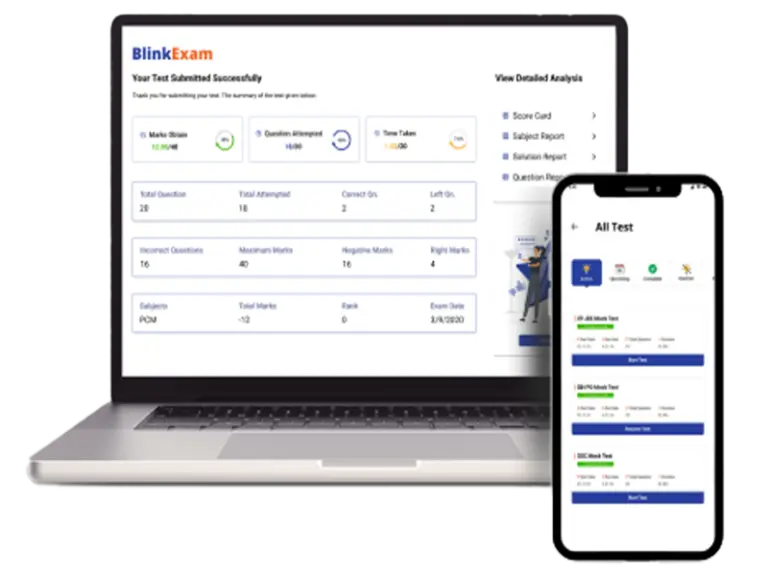
Results and analytics land the moment an exam closes. Scorecards, subject-wise breakdowns, and comparison reports are easy to share with faculty—no spreadsheet cleanup afterward.
See BlinkExam in
action. Free for 7 days.
No credit card required. Get a personalized walkthrough with our solutions team and run a live pilot exam on your own candidates.